


Commentary: The Community of Innovation: Why Engineers Need to Be in the Room
The Community of Innovation: Why Engineers Need to Be in the Room
By Angelo Collins
VFS Executive Director
Progress in vertical flight has never happened in isolation. It has always been the result of engineers, researchers, operators and innovators coming together to exchange ideas, challenge assumptions and learn from one another to build a shared technical foundation.
Professional societies like the Vertical Flight Society have supported this kind of exchange for decades. Since 1943, VFS has provided a forum where engineers from government, industry and academia can gather to discuss the challenges and opportunities facing rotorcraft and other vertical flight technologies. Army and Navy engineers working alongside industry designers, NASA researchers exchanging ideas with university faculty, and early-career engineers presenting their first technical papers all contribute to a quiet but powerful community behind innovation.
In many ways, this tradition goes back to the origins of the field itself. In the 1930s, rotary-wing pioneers were scattered across the United States and around the world with few opportunities to share ideas. To address this, the first Rotating Wing Aircraft Meeting was held at the Franklin Institute in Philadelphia in October 1938, which brought together innovators such as Igor Sikorsky, Frank Piasecki, Arthur Young, W. Laurence LePage and Wallace Kellett. Simply putting these pioneers in the same room created an environment where ideas and solutions could be exchanged openly, helping establish the collaborative culture that continues to shape the vertical flight community today.
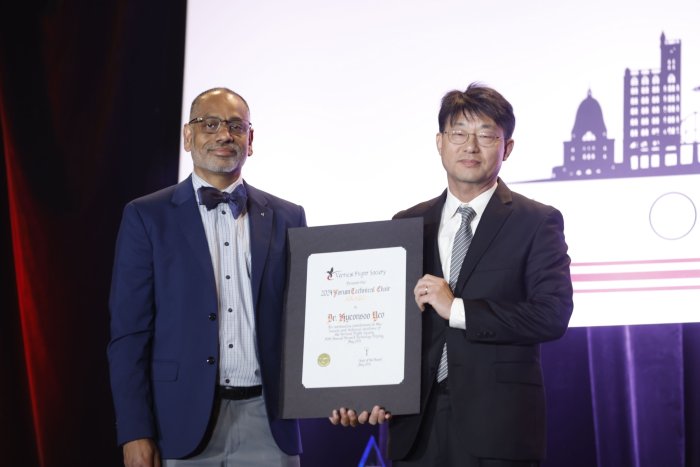
The Forum 80 Technical Chair, Dr. Hyeonsoo Yeo, of the US Army Combat Capabilities Development Command (DEVCOM) Aviation and Missile Center (AvMC), was recognized by VFS Technical Director Dr. Mahendra J. Bhagwat, also of US Army DEVCOM, for his prodigious efforts in helping pull together the excellent technical paper program at Forum 80
That community matters just as much today as it did decades ago.
Across the aerospace sector, we are entering a period of remarkable technological momentum. Military modernization programs are advancing next-generation rotorcraft capabilities. NASA continues to explore new concepts for efficient and sustainable vertical lift. Meanwhile, commercial developers are pursuing new aircraft and operational models for cargo, urban mobility and other emerging missions. These developments span a wide range of disciplines. None of these challenges can be solved within the walls of a single organization.
Vertical flight is inherently interdisciplinary, and progress often depends on the ability of engineers and researchers to exchange technical insights across institutional boundaries. Government scientists bring deep understanding of operational requirements and long-term research priorities. Industry engineers contribute practical experience in design, manufacturing and certification. Academic researchers push the frontiers of theory and basic research while educating the next generation of engineers.
When these perspectives meet in the same room, ideas move faster.
A recent example illustrates this point well. This January, VFS convened a VTOL UAS Basic Research Workshop at the University of Maryland, bringing together engineers and research from the US Army, Navy, academia and industry. The goal was not simply to brief, but to collaboratively examine where the most important research opportunities lie in the coming years.
The workshop produced a 45-page report identifying key technologies, capability gaps and potential payoffs for both military and civil applications. Just as important as the findings was the process itself — government laboratories, university researchers and industry engineers working together to assess the challenges facing the field. The report is now undergoing further review by VFS technical committees.
Efforts like this highlight the importance of professional forums. They provide a neutral setting where ideas can be examined openly, technical priorities refined and the broader community kept connected to emerging developments. For government, industry and academia alike, these interactions help maintain technical awareness, guide research and development, and cultivate the next generation of vertical flight innovators.
In an era where collaboration increasingly happens through digital platforms and remote communication, there is still something uniquely valuable about being physically present in the room. Technical conversations move more naturally. Questions spark follow-on discussions. Relationships form that later grow into research partnerships, program collaborations and lifelong professional connections.
The vertical flight community has benefited from this culture of exchange for more than 80 years. As our field continues to evolve, spanning military, civil and emerging applications, the importance of that shared technical community will only grow. Ensuring that innovators can be in the room remains one of the most important investments we can make in the future of vertical flight. So, will we see you at Forum 82?
What do you think? Let us know!
Posted: 2026-03-16